
Event-Free Human Performance: What a Farm, a Reactor, and a Slice of Swiss Cheese Taught Me
Author: Larry Fisher, Human Performance Consultant
Human Performance = Behavior + Results
I have a lifelong passion which I am excited to share with you. That passion is for Human Performance. I do also want World Peace, but what I find most rewarding is making a difference in how people safely perform their day-to-day tasks from start to finish, without events happening.
So how do you define Human Performance in five words or less? Behavior plus results. Put another way, it’s getting the results you expect, nothing more and nothing less. That’s easier said than done, but it’s far from impossible.
Why Behavior Comes First
People often ask me, “How do you do what you do?” My answer is care and understanding. The hardest part to teach is understanding humans, because understanding human behavior means understanding human error. The most important aspect to internalize mentally is that it is human nature to error. Once we accept that, we can start making small changes here and there that add up to a big difference.
Behavior at work starts with your organization’s Safety Culture: the values and behaviors modeled by leaders and internalized by members that make safety the overriding priority. Practicing and believing in it, from team leaders to team members, is what makes event-free operation possible. It has to be more than a vision on a wall.
I’ve helped develop and strengthen Safety Culture at companies across North America, in petrochemical, nuclear generation, nuclear laboratories, gas pipeline, and electrical distribution. I’ve seen the results first-hand.
Where It All Started: My Grandfather’s Farm
At age five, I began spending my summers on my grandfather’s farm. He employed seasonal migrant workers to work the fields and care for the animals. Every morning he gathered us all to talk through the day’s work, including who was responsible for calling for medical help if it was needed. Everyone verbally confirmed their roles.
At the end of each day, we met again to talk about what happened and how to make tomorrow better.
Without knowing it, I was watching Human Performance Tools in action: Pre-Job Briefing, Three-Way Communication, Effective Communications, and Post-Job Review.
Farm accidents can leave lifelong physical injuries and mental images. I still have a vivid memory of one that caused devastating suffering, not only for the injured person and their family, but for everyone who was there. That memory never leaves you.
Trying It Out in the Real World
In secondary school, I worked part-time for a landscaping company. I asked the owner if I could start each day the way my grandfather did, by talking with the whole crew. My co-workers’ body language suggested they wondered who this kid thought he was. But acceptance was immediate, and the team felt more organized and more involved in the day’s decisions. The owner then asked me to write down the process so anyone could follow it when I wasn’t there. That was Procedural Compliance, and my passion kept growing.
The Petrochemical Industry: A Slogan Isn’t a Culture
My first job after school was in petrochemicals in the early 1970s, an industry with a poor safety reputation. One company adopted the slogan “Life is Fragile.” Sadly, and ironically, there was a fatality within 48 hours of launching it. The root cause analysis found the campaign hadn’t been rolled out universally or supported by the whole company.
Every company I’ve worked with has some version of this story: improvements that came only after an accident and its root cause analysis. Has that happened where you work?
Nuclear: Learning From Disaster
In 1974, I moved into the Canadian nuclear industry, then very young and burdened by the image of the atomic bomb. Despite that reputation, I felt safer there, because the utility had an Event Free Tool program built around STAR: Stop, Think, Act, Review.
The history that followed shaped the whole field:
- March 16, 1979: The China Syndrome, a fictional film about a reactor meltdown, opens in theatres.
- March 27, 1979: Just eleven days later, the Three Mile Island accident occurs. Public opinion of nuclear power plummets, and the Institute of Nuclear Power Operations (INPO) is formed to make sure it never happens again at a U.S. commercial plant.
- April 26, 1986: Chernobyl. The World Association of Nuclear Operators (WANO) is created. Together, INPO and WANO remain the safety benchmark for North American nuclear stations, and poor ratings can put an operating license at risk.
- 2006: INPO issues Human Performance Tools for Workers. Mistakes still happen. Why? Root cause analysis showed that supervisors and managers hadn’t been included in the original training.
- 2007: INPO issues Human Performance Tools for Managers and Supervisors.
- 2009: The U.S. Department of Energy publishes its two-volume Human Performance Improvement Handbook, based on the INPO documents.
- March 11, 2011: Fukushima. We’re still learning, and the DOE handbooks remain under review today.
Understanding Human Error
A few things can affect your performance. These are called Error Precursors, and they fall into four groups: task demands, individual capabilities, work environment, and human nature. Examples include time pressure, irreversible critical tasks, unfamiliar tasks, personality conflicts, and stress.
“Fit for Duty” doesn’t just mean not being under the influence. It means being physically and mentally focused and able to perform a task you’re qualified to do.
Feeling stressed yet? Relax. Awareness is the first defense, and Performance Modes give you a way to build it.
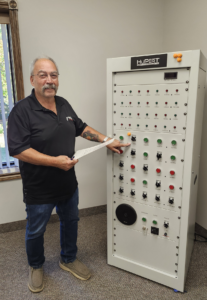
Training with the HuPerT® 1000 human performance training device
The Three Performance Modes
- Skill-Base Mode covers routine tasks you do daily, often without thinking, like using a hammer’s claw to pull a nail. The chance of error is about 1 in 10,000, but accidents still happen.
- Rule-Base Mode is the “when this happens, I do this” mode, where you respond from memory rather than from the procedure. Picture a nuclear station system trip. A high-level alarm sounds, and an experienced operator says, “I need to open the pump discharge valve more,” and restarts the system. In reality, a low-level alarm had tripped the discharge pump off, the tank overfilled, and the high-level alarm then tripped the entire system. The alarm response manual would have flagged exactly this possibility. The chance of error here is about 1 in 1,000.
- Knowledge-Base Mode is where a worker has an inaccurate mental model, as in troubleshooting. It causes the most unrecoverable situations, and it’s where even experienced workers make irreversible mistakes. The chance of error is about 1 in 2.
Which mode do you work in day to day? Which one do you think is safest? These questions should come up at every stage of the work.
A Three-Step Approach: Before, During, After
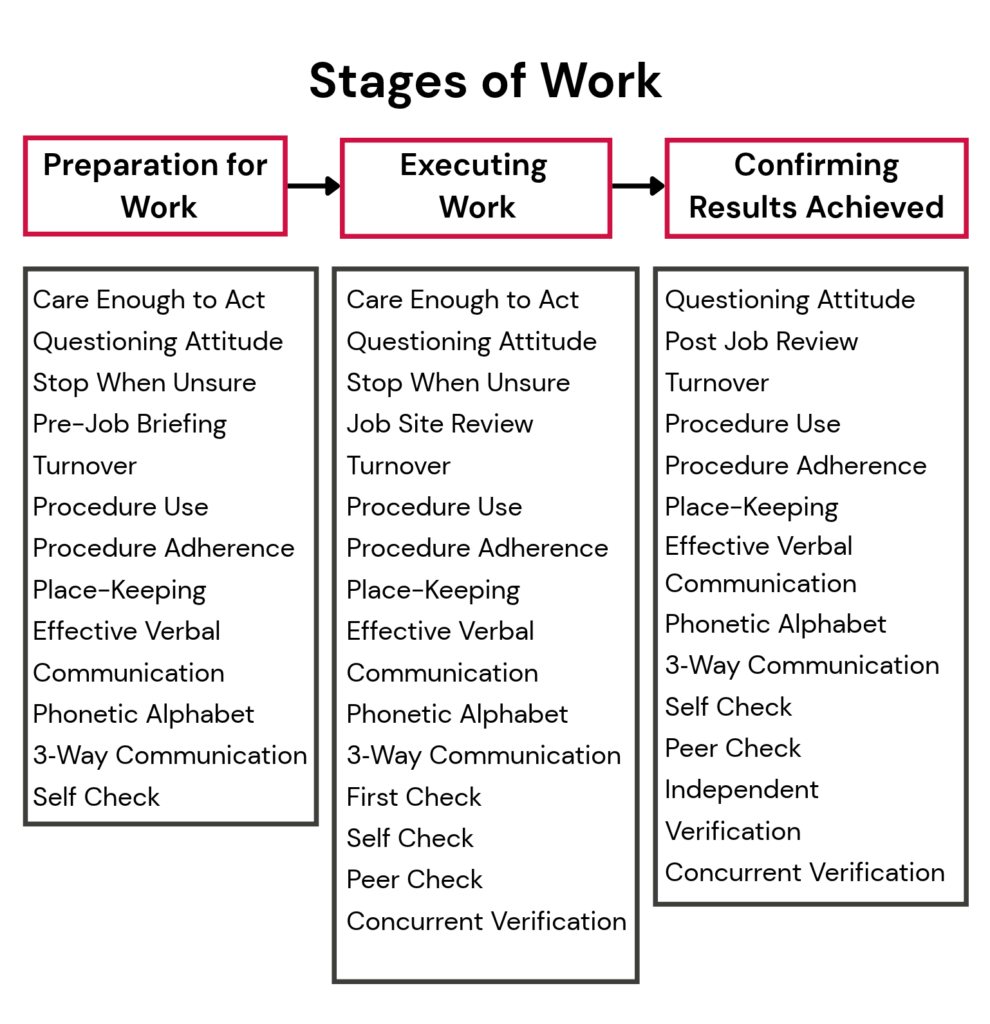
Using three stages of work, we can apply the right tools at the right time:
- Prepare. Hold a Pre-Job Briefing. Discuss stopping when unsure, using procedures, and caring enough to ask. A well-briefed team executes better.
- Execute. Keep the briefing tools in play and have every team member continuously apply STAR.
- Review. The job isn’t over when the task is done. Document what went as expected and what could have gone better, so the next Pre-Job Briefing includes that Operating Experience (OPEX).
Teaching It: The Swiss Cheese Model
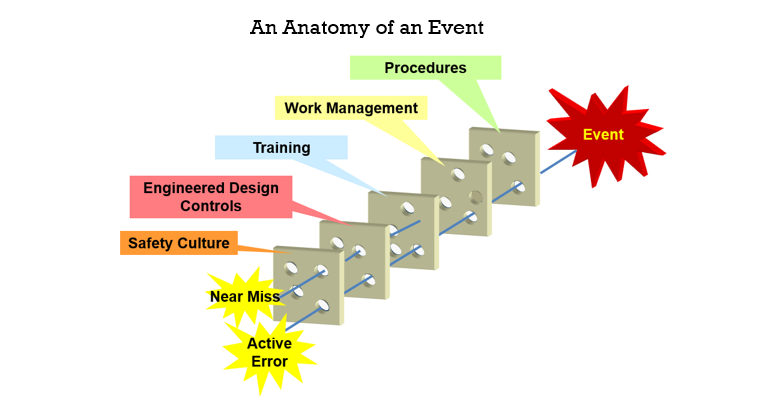
After Three Mile Island, and before INPO’s 2006 document, psychologist James Reason introduced the Swiss Cheese Model, or the “Anatomy of an Event.” For me, it was the missing piece in the event-free process I’d first learned in Canadian nuclear utilities.
Each slice of cheese is a barrier that helps prevent errors. The most important is Safety Culture, followed by Design, Training, Work Management, and Procedures. Every slice has holes. When the holes line up and all the barriers fail, an event will happen.
The Human Performance Toolbox
Here is what happened with respect to the Human Performance Tools.
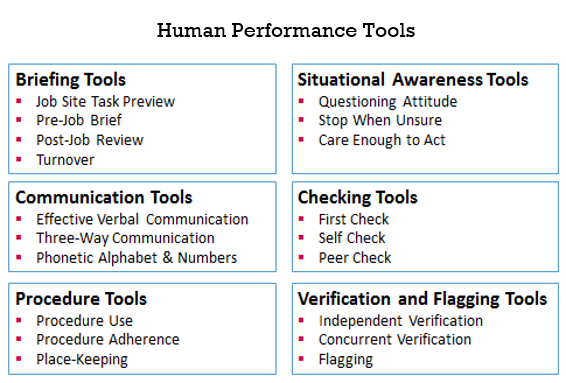
A group called the Institute of Nuclear Power Operators did a root cause analysis on the event at Three-Mile Island Nuclear Power Plant and found 19 elements (tools) that contributed to the event.
I classified the 19 essential tools into six key categories: BRIEFING, COMMUNICATION, SITUATIONAL AWARENESS, CHECKING, VERIFICATION, and FLAGGING. This strategic organization was designed to enhance understanding and facilitate effective teaching when I developed the course.
Your Turn
Now for the scary part. Sit down with your direct reports, peers, and managers and share what you’ve learned here. Challenge them to review every event from this year and last, and run a root cause analysis using the nineteen Human Performance Tools to see which ones, had they been used, might have prevented it.
The harder task is looking honestly at how you plan and perform work today, and deciding what you need to change today, tomorrow, and for good.
Where does your organization stand? Let’s talk about how Human Performance Tools can reduce errors and keep your people safe. Get in touch today.
